Marriage needs at least three different kinds of support: preparation, prayer, and practical advice. Through this blog, I'm trying to offer all three. Please join in the community and add to the conversation, so that we can all support each other.
Friday, May 17, 2013
Preaching, Teaching, and Washing Dishes
"Wash more dishes," my spiritual director inevitably advises me. This kicks off a prolonged spate of whining on my part. My children are brilliant whiners, and they have taught me well. "But ... I'm not good at it!" I insist plaintively, sometimes silently, sometimes out loud. "And I don't like it. And I didn't do enough of it as a kid. Or as a young adult. I'm not meant to wash dishes. I'm better than that! And who cares about dishes anyway?" Oh, wait, the Holy Father recently told us no whining? But...
I have always idealized the day that all this housewifery will end and I can "go back to work." In my fantasies, someone else will clean the house and help the children do homework, while I wear fancy suits (yes, I know no one does this any more -- humor me) and stand in the spotlight. After all, didn't Our Blessed Mother take on a completely new role after the Ascension of Our Lord into heaven? She guided, supported, and advised the new church in Jesus' absence. The New Testament didn't exist yet, so who was there to tell the stories of Jesus' early life? Mary. She could teach the disciples about the message from the Angel Gabriel, who told her that the child to be born to would be called the Son of the Most High, and his kingdom would last forever. Mary could tell of how she lost the child Jesus in Jerusalem and found him again in the temple after three days, the holy temple that Jesus called "my Father's house." All the things she had been pondering in her heart, she could tell to the apostles and the disciples as they waited in the upper room for the coming of the Holy Spirit on Pentecost. In a way, she was preaching the Good News to them, teaching them about her son.
"But who do you think was doing the dishes? Who was cooking and cleaning for the apostles in the upper room?" a priest asked recently. Dishes?! Again!?! Is the work of a woman really never done? But it isn't too much of a stretch to think that Mary was taking care of the apostles the same way she always took care of her son Jesus as he grew up in her home. At the wedding of Cana, Mary noticed when the wine ran out, even when it wasn't her party. She asked Jesus to take care of what was essentially a domestic task, and he did. Mary paid attention to these things.
Certainly, Mary could preach, teach, and wash dishes. If anybody could do it all, she could. But there are other women to show us the way as well. St. Gianna Berretta Molla worked as a doctor and a mother while developing an intense interior holiness. Popular Catholic blogger Jennifer Fulwiler took care of five young children while writing posts for the National Catholic Register while being eight or nine months pregnant in the hospital with pulmonary embolisms. My favorite recent post of hers? Because why even have a blog if you can't write chatty posts while stuck in the hospital? As well-known as Jennifer is, she still says she devotes only 10% of her day to writing and the rest to her home and kids.
So no matter what else we do in life, most moms are going to wind up having to wash at least a few dishes. And the sooner we (okay, I) accept that reality, the sooner the whining will stop. Like, maybe, tomorrow. Or next week...
Photo Credit: miss pupik via Compfight cc
Wednesday, May 15, 2013
The Way We Met
When we taught pre-Cana classes together, my husband and I never got much of a response to questions like "So what made you fall in love?" But almost everyone had a great story about the way they met. My friend Trista, who's getting married super-soon, just wrote a blogpost about how she met her fiance Brian online. So, I figured Manny and I could share our story, as wedding season kicks off. Please tell us about your story in the comments!
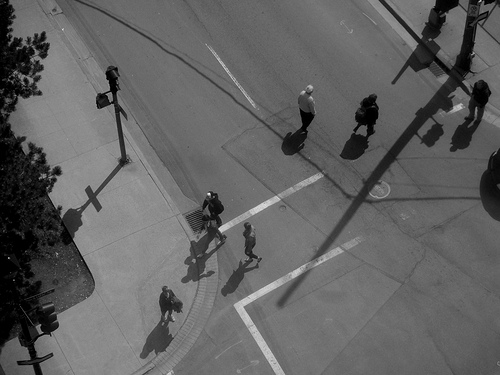
Manny and I actually met twice. The first time, we ran into each other by chance. I was crossing the street in one direction, trying to get to work on time. He was crossing the street in the other direction, together with my friend Ayman from college. I waved to Ayman, exchanged a few pleasantries, and zoomed off to the office. The way Manny tells it, he then turned to Ayman and said something like "Who was that?" Ayman told Manny that I was not Manny's type. And that was that. At least for the next two years.
Fast forward to Ayman's big party in Brooklyn to introduce his American friends to his Spanish girlfriend. The girlfriend's name was Eva. Ayman and Eva met in Spain during the Fería de Abril, held every year just after Easter. Ayman caught Eva's attention when he strode up to the stage in the front of one of the immense festival tents and began playing flamenco guitar. Ayman didn't speak Spanish and Eva didn't speak English, so they communicated in French. In the summer that Ayman threw the big party in Brooklyn, Eva had traveled to stay with her relatives in New York to see if there was any future for her and Ayman. (Now they are happily married with two great kids!) Eva's very nice American cousin, also attending the party, was named -- Manny.
Manny approached me at the party and asserted that we had met before. Unfortunately, I had no recollection of that event. "We did meet two years ago," he insisted, "while we were crossing the street." Neon <<STALKER!>> bulbs started flashing in front of my eyes. "Maybe not," he temporized. Ah, and then he quoted Tolstoy. Something about how the course of a man's life could be irrevocably changed because on a certain day he met a certain woman wearing a dress that curved in just a certain way. All was forgiven.
After the party, a few of us went out to a bar to play pool. Manny was a fearsome pool shark. A doctor, who spoke Spanish, and read Tolstoy, and played a mean game of pool. I couldn't resist. As it got later in the evening, he still hadn't asked for my phone number. Oh, well, I thought, dejected. I began to walk out the door. Hearing him call out my name, I turned to look behind me. Casually lounging back on his chair, Manny crooked his finger at me as cigarette smoke swirled around the noisy bar. Roll cameras, please. Then he asked for my email address. {{Sigh.}} I walked out of the bar smiling, and he's kept making me happy ever since.
Crossing Street Photo Credit: Avard Woolaver via Compfight cc
Manny and I actually met twice. The first time, we ran into each other by chance. I was crossing the street in one direction, trying to get to work on time. He was crossing the street in the other direction, together with my friend Ayman from college. I waved to Ayman, exchanged a few pleasantries, and zoomed off to the office. The way Manny tells it, he then turned to Ayman and said something like "Who was that?" Ayman told Manny that I was not Manny's type. And that was that. At least for the next two years.
Fast forward to Ayman's big party in Brooklyn to introduce his American friends to his Spanish girlfriend. The girlfriend's name was Eva. Ayman and Eva met in Spain during the Fería de Abril, held every year just after Easter. Ayman caught Eva's attention when he strode up to the stage in the front of one of the immense festival tents and began playing flamenco guitar. Ayman didn't speak Spanish and Eva didn't speak English, so they communicated in French. In the summer that Ayman threw the big party in Brooklyn, Eva had traveled to stay with her relatives in New York to see if there was any future for her and Ayman. (Now they are happily married with two great kids!) Eva's very nice American cousin, also attending the party, was named -- Manny.
Manny approached me at the party and asserted that we had met before. Unfortunately, I had no recollection of that event. "We did meet two years ago," he insisted, "while we were crossing the street." Neon <<STALKER!>> bulbs started flashing in front of my eyes. "Maybe not," he temporized. Ah, and then he quoted Tolstoy. Something about how the course of a man's life could be irrevocably changed because on a certain day he met a certain woman wearing a dress that curved in just a certain way. All was forgiven.
After the party, a few of us went out to a bar to play pool. Manny was a fearsome pool shark. A doctor, who spoke Spanish, and read Tolstoy, and played a mean game of pool. I couldn't resist. As it got later in the evening, he still hadn't asked for my phone number. Oh, well, I thought, dejected. I began to walk out the door. Hearing him call out my name, I turned to look behind me. Casually lounging back on his chair, Manny crooked his finger at me as cigarette smoke swirled around the noisy bar. Roll cameras, please. Then he asked for my email address. {{Sigh.}} I walked out of the bar smiling, and he's kept making me happy ever since.
Crossing Street Photo Credit: Avard Woolaver via Compfight cc
Friday, May 10, 2013
Kids, Birds, and Bees (A Review of Growing Up in God's Image)
"What have I taught you about, God, love, marriage and, uh, sex?" I recently asked my twelve-year-old daughter. "Well, in school, they told us about how boys grow whiskers about the time they start to date. And they showed us gross drawings of bodies," she grimaced. "Anything about God or love?" I asked. "No," said my sweet parochial school student. "Did I teach you -- anything?" I asked. Awkward grins on both faces. Again came my daughter's answer, "No." And I realized that I had somehow managed to leave out something really important.
Part of why my husband and I hadn't gotten around to the birds and the bees talk was because we were afraid of doing it wrong. We would occasionally search for a book to help us explain the beauty of God's plan for our bodies to our children in an age-appropriate way. We never really found one until now. Growing Up in God's Image, by Carolyn J. Smith, is that book.
Growing Up in God's Image seeks to provide its readers with a new approach to the facts of life talk, both in what to say and how to say it, as the book's subtitle explains. This "new" approach, which fortunately is no longer so new, relies heavily on Pope John Paul II's Theology of the Body. The book's three main sections explore the meaning of spousal love -- that is, the love between man and wife -- through explaining (1) the Trinitarian love between the Father, Son and Holy Spirit, (2) the love of Christ in the Holy Eucharist, and (3) love as a sacramental sign of total self-giving. Scattered throughout are unexpected Scriptural insights, some of which actually gave me chills.
The beginning of Growing Up in God's Image contains themes that can be discussed with kindergarteners, including what the story of Adam and Eve teaches us about God's plan for marriage and families, and how parents cooperate with God in creating new life. Later parts of the book include detailed descriptions of the changes that come with puberty as well as matter-of-fact explanations of intercourse and pregnancy. The author, an experienced mother of ten, recommends presenting biological information in the context of growth of the entire person, including physical, emotional, mental, and spiritual growth. She prompts parents to remind their children to pray for their vocation, for wisdom to see if God is calling them to married life, or perhaps to the priesthood or religious life.
The end of the book is more of a study guide, posing questions without providing answers other than cites to paragraphs of the Catechism. I could see this guide being especially useful in the high school years, after confirmation, particularly if your child is not attending a Catholic high school and is therefore no longer receiving religious instruction. Home schoolers and youth groups might also benefit from it.
My favorite features of the book are the practical instructions to parents. The author includes a lot of how-to advice, such as at what age to raise certain issues, which parent should present the information, and which parts of the book can be read by a parent and child together. It contains scripts you can repeat verbatim in case you as the mature parent actually freeze or choke when confronted with the reality and the enormity of the task in front of you. There are even diagrams in case of confusion.
Although packed with information, Growing Up in God's Image is shorter than you might expect, at only 74 pages long. The passages about dating could easily be expanded to address today's hook-up culture more directly. Also, in advocating a steady progression from group dates or parties to double dates to steady dating and courtship, the book seems to underestimate the dangers of peer pressure to engage in inappropriate behavior, starting at Spin the Bottle and escalating from there. Nonetheless, the book succeeds in its main purpose of helping parents explain sexuality to their children in a context of discovering God's plans for their lives, and I'm so glad we found it. Now, you'll have to excuse me, because I need to go talk to my daughter about the birds and the bees.
To purchase this book from Amazon, click here.
Tuesday, May 7, 2013
Letting Your Child Go With God: A First Communion Story
I cried at my eldest daughter's First Communion, but promised myself that I wouldn't cry for my middle daughter's. No such luck. Standing behind my sweet Maria as she received communion from the priest, I broke down and barely managed to receive the host myself. As for the wine, forget it.
Much to my delight, my daughter Maria chose to receive Holy Communion in the mouth rather than in the hand. During the First Communion training session, the Director of Religious Education told the children they could receive the host either in their hands or in their mouths. Then the Catholic schoolteacher told the children they had to receive in the hand only. Our poor Maria was confused as to which instruction to follow.
My husband and I receive in the mouth, an action which has deep meaning for us. Christopher West talks about how human beings should receive God's love trustingly, rather than grasping for it; he says that receiving Holy Communion in the mouth reflects the proper receptivity toward Our Lord. My husband and I also have a prayer card of Mother Teresa, in which she says that out of all the things she has seen in this world, what makes her saddest is when people receive communion in the hand rather than in the mouth. We told Maria that no one, not even her teacher, could take away the right to receive Jesus in a more reverent manner.
But I was scared. A kid not used to receiving in the mouth and a Eucharistic Minister not used to distributing the host that way could very well be a recipe for disaster. Maria and I practiced over and over. "Body of Christ," I said, and she opened her mouth with her tongue curling up almost all the way to her nose. "No, no," I giggled. "Put your tongue out, not up! Try again." Again she walked solemnly up to me, and this time stuck her tongue out at a steep downward angle. I had visions of the host rolling all the way to floor. "Out, not down," I said, starting to think we should give up on the whole thing. "Like a shelf!"
On the day of Maria's first Holy Communion, Manny and I walked up the altar steps behind our daughter as she stood in front of the priest to receive. I realized that there was no way I could possibly dive in front of her fast enough to catch the host if it fell. This was up to Maria and the priest. She opened her mouth, the priest carefully placed the host inside, and I started to bawl. She walked up to receive the wine, and let it touch her lips. No funny face, no spitting, no gulping. My little girl, all grown up.
Maria's relationship with God was moving out of my purview. It was becoming more her responsibility. The Holy Spirit had nestled within her soul at the moment of her baptism, and the Bread of Life had entered her body at the moment of her First Communion. God's path for her -- not my path for her -- was ready and waiting. My mind turned to Maria's future confirmation, and then to her wedding or her profession of vows to religious life. God had prepared a path for her, I had led her to it, but it will be up to Maria to walk down that path on her own two feet. Is she ready? Am I ready?
At the end of the day, after the party guests had gone home, and Maria's pretty veil and tiara had been stored away for her younger sisters on their special days, Maria turned to me and smiled. "I can't wait until next Saturday," she said. "Why?" I asked. "Daddy promised to take me to Mass," she answered, beaming. "It will be my Second Holy Communion!"
Oh, yes, I thought. She's ready.
En español: Como Crecen los Hijos
Friday, May 3, 2013
Michele's Story: Why I Fast for Marriage
In today's post, read about the powerful story of Michele's healing from grief and her passionate commitment to the New Evangelization. Learn why Michele has joined the U.S. bishops' campaign of prayer and fasting for life, marriage, and religious liberty. This post is part of a year-long series about fasting. Read other posts here: Fasting and Marriage, Day 1, Day 2, Day 3, and Vivian's Story.
1. Please tell us about yourself.
My name is Michele Coldiron. My husband, Ronn, and I were married in June 1977, more than 30 years ago! We have four children, three girls and a boy, as well as one 3-year-old grandchild. Our youngest daughter is a freshman at the Ohio State University. Our eldest child, a son, died at the age of 19 while a student at UC-Santa Barbara in 1998. Although I did not notice my emotional state in my struggle to present a loving face to the rest of the family, the following seven years were grinding me down slowly but surely, because of my strong feelings of guilt for our son's death. I consider his death a casualty of what Blessed John Paul called the "culture of death."
On October 7, 2004, I encountered Jesus Christ, who pulled me from my desert of pain and anguish, healed me physically and set me to work to help in the New Evangelization. Thanks be to God. I cried for the first time in years at 3 am, October 8. (Listen to Michele’s radio interview about her healing from grief through finding a new life in Christ here )
Eight years ago, I helped found the California Catholic Women's Forum, and became its executive director. In one of its initiatives, CCWF presented a five-year series of discussion forums on Blessed John Paul II's Apostolic Letter Mulieris Dignitatem (On the Dignity of Women). We also began filming a series of classes on what it means to be human being, based on the Theology of the Body and other works. The first class in the series is The Meaning of Love. We plan on filming The Meaning of Manhood in 2013.
CCWF also promotes the music of the Church. In 2010, we recorded Tota Pulchra , a CD of Marian songs. The following year, our singing group toured the three cathedrals of San Francisco Bay. We sang in San Jose in 2012 (click here for a youtube video of the performance), and are planning concerts in Sacramento this fall and more.
We are currently expanding our outreach under a new name, Creative Catholic Works. Our new web site is already under construction.
2. Why have you responded to the bishops’ Call to Prayer?
As someone who grew up in the 1960's and 70's, I witnessed attacks on authority at all levels of human interaction. Though the intent was often good, the outcome has too often been a slippery slope toward a radical individualism and hedonistic way of life, which will result neither in a healthy civil society, nor in leading individual souls to their true home in Heaven.
I feel that every Catholic who loves Christ and loves the Roman Catholic Church should heed the bishops' call to prayer! As I went through a period of time in my own "desert of pain and anguish", so has the Church been through a time of serious change and attack. But the times are not as dire as they may seem, if one's eyes are turned toward the source of hope, Jesus Christ.
In this unified effort of the bishops, it is a beautiful thing to see the hierarchy of the Church acting as one, reflecting the true teaching of the magisterium. The current attack on faith in the form of the HHS mandate is a deliberate attack with grave consequences for freedom of speech, and the freedom of association which is so much a part of the American fabric. Prayer is the most effective response. Prayer will do the most, for God desires us to reach out from our hearts in supplication, asking Him to help. (Read more of Michele’s thoughts on these topics here -- fortnight of prayer, definition of marriage, thoughts on the marriage mandate, contraception, overpopulation myth)
3. Why do you believe in the cause of life, marriage, and religious liberty?
Where would we be without life in the first place? Each of us was conceived and born. Each of us was a twinkle in God's eye before we ever became a twinkle in our parents' eyes! We are fallen mortals, and we rupture the fine cloth of history that God is eternally creating with almost every errant thought. But God is so patient, and He has an infinite number of designs He can weave as life moves through time.
In our struggle to reflect God, who is love, in our daily lives, we can rely on the sacraments that God gave us through Jesus, the Word made flesh, and His Advocate, the Holy Spirit. Marriage is the primordial sacrament. The union of a man and woman in matrimony is the closest we can get to replicating the self-giving love that is the Trinity. Man and woman come together and co-create new life in partnership with God. God's love is made visible for us through the sacrament of marriage. It is a beautiful and joyful duty to uphold this sacramental reality.
Moreover, our founding fathers held the Bible as the ultimate source of wisdom and created a government based on principles given to us by God and discernible through reason, as natural law. Thus, religious liberty, together with the whole Bill of Rights, is a reflection of God's life in our country, and not to be taken lightly. America was created as a country that believes in inalienable rights, endowed by Our Creator. Among these rights are life, liberty and the pursuit of happiness. These words are not just fine writing by Thomas Jefferson! They mean something, and that something is faith in the laws of nature and of nature's God. The attacks on religious freedom in recent years are growing in number but they can be overcome with prayer and fasting, mercy, and trust in the providence of God.
4. What do you believe that fasting and prayer can accomplish both in your spiritual life and in the world?
Fasting allows us to realize that we are mere mortals. It helps us realize our dependence on the gifts with which we are surrounded —air, water, food, shelter, clothing. All are gift. Prayer is the natural accompaniment to this realization. How grateful we become to Him from whom these gifts flow!
Prayer is primarily a method of thanking our Creator for being alive, and for giving us the opportunity to work in his vineyard. It is an opportunity for us to request the tools we will need in our work. It is an occasion for us to ask forgiveness for those times we have not worked our hardest as tillers in the field of faith. And finally, it is an occasion for us to bow our heads in collective wonderment and adoration of the power of Almighty God, who chose to come to earth as a mere man, in order to lead us, like the Good Shepherd He is, to the Father's mansion.
5. Can you mention any examples of other friends, family, or fellow parishioners who are also answering the bishops’ call?
The biggest proponent of the bishops' call that I know of in my area is Our Lady of Peace Shrine and Parish in Santa Clara, CA. In addition to having a speaker for every night except Sundays for the Fortnight of Prayer (June 21 – July 4, 2012) as requested by the US Conference of bishops, Our Lady of Peace is now hosting a yearlong study of the documents of Vatican II, as part of this Year of Faith. I recently led a discussion at the parish on Dei Verbum, the Dogmatic Constitution on Divine Revelation, a most important document of Vatican II.
6. Have you seen any positive results in your own life or elsewhere because of the Call to Prayer?
I have noticed that being called to prayer by someone other than my own inadequate self has tended to make me more consistent in my prayer life. It is difficult to make pacts with yourself on how and when to pray—things always seem to "come up..." However, when the call is from someone else, particularly from our spiritual shepherds, then the desire to participate is more intense and more likely to bear fruit.
7. What is the top reason you think that other people should answer the bishops’ call?
God calls us to pray. God calls us through his shepherds, the bishops. If one reads the Bible, one notices quickly how often disaster has been averted through intense prayer on the part of the people of God. In our society, which can be so comfortable and in which it can be so easy to forget God is there and that He is holding existence in the palm of His hand, it is even more important to join with our Biblical brothers and sisters, part of those who comprise the Communion of Saints, including the martyrs such as St. Thomas More, St. Edith Stein, St. Maximilien Kolbe, and the saints of the Cristeros war in Mexico. I could go on and on.
God wants us to pray. That is why we should answer the Bishops' call, first and foremost.
1. Please tell us about yourself.My name is Michele Coldiron. My husband, Ronn, and I were married in June 1977, more than 30 years ago! We have four children, three girls and a boy, as well as one 3-year-old grandchild. Our youngest daughter is a freshman at the Ohio State University. Our eldest child, a son, died at the age of 19 while a student at UC-Santa Barbara in 1998. Although I did not notice my emotional state in my struggle to present a loving face to the rest of the family, the following seven years were grinding me down slowly but surely, because of my strong feelings of guilt for our son's death. I consider his death a casualty of what Blessed John Paul called the "culture of death."
On October 7, 2004, I encountered Jesus Christ, who pulled me from my desert of pain and anguish, healed me physically and set me to work to help in the New Evangelization. Thanks be to God. I cried for the first time in years at 3 am, October 8. (Listen to Michele’s radio interview about her healing from grief through finding a new life in Christ here )
Eight years ago, I helped found the California Catholic Women's Forum, and became its executive director. In one of its initiatives, CCWF presented a five-year series of discussion forums on Blessed John Paul II's Apostolic Letter Mulieris Dignitatem (On the Dignity of Women). We also began filming a series of classes on what it means to be human being, based on the Theology of the Body and other works. The first class in the series is The Meaning of Love. We plan on filming The Meaning of Manhood in 2013.
CCWF also promotes the music of the Church. In 2010, we recorded Tota Pulchra , a CD of Marian songs. The following year, our singing group toured the three cathedrals of San Francisco Bay. We sang in San Jose in 2012 (click here for a youtube video of the performance), and are planning concerts in Sacramento this fall and more.
We are currently expanding our outreach under a new name, Creative Catholic Works. Our new web site is already under construction.
2. Why have you responded to the bishops’ Call to Prayer?
As someone who grew up in the 1960's and 70's, I witnessed attacks on authority at all levels of human interaction. Though the intent was often good, the outcome has too often been a slippery slope toward a radical individualism and hedonistic way of life, which will result neither in a healthy civil society, nor in leading individual souls to their true home in Heaven.
I feel that every Catholic who loves Christ and loves the Roman Catholic Church should heed the bishops' call to prayer! As I went through a period of time in my own "desert of pain and anguish", so has the Church been through a time of serious change and attack. But the times are not as dire as they may seem, if one's eyes are turned toward the source of hope, Jesus Christ.
In this unified effort of the bishops, it is a beautiful thing to see the hierarchy of the Church acting as one, reflecting the true teaching of the magisterium. The current attack on faith in the form of the HHS mandate is a deliberate attack with grave consequences for freedom of speech, and the freedom of association which is so much a part of the American fabric. Prayer is the most effective response. Prayer will do the most, for God desires us to reach out from our hearts in supplication, asking Him to help. (Read more of Michele’s thoughts on these topics here -- fortnight of prayer, definition of marriage, thoughts on the marriage mandate, contraception, overpopulation myth)
3. Why do you believe in the cause of life, marriage, and religious liberty?
Where would we be without life in the first place? Each of us was conceived and born. Each of us was a twinkle in God's eye before we ever became a twinkle in our parents' eyes! We are fallen mortals, and we rupture the fine cloth of history that God is eternally creating with almost every errant thought. But God is so patient, and He has an infinite number of designs He can weave as life moves through time.
In our struggle to reflect God, who is love, in our daily lives, we can rely on the sacraments that God gave us through Jesus, the Word made flesh, and His Advocate, the Holy Spirit. Marriage is the primordial sacrament. The union of a man and woman in matrimony is the closest we can get to replicating the self-giving love that is the Trinity. Man and woman come together and co-create new life in partnership with God. God's love is made visible for us through the sacrament of marriage. It is a beautiful and joyful duty to uphold this sacramental reality.
Moreover, our founding fathers held the Bible as the ultimate source of wisdom and created a government based on principles given to us by God and discernible through reason, as natural law. Thus, religious liberty, together with the whole Bill of Rights, is a reflection of God's life in our country, and not to be taken lightly. America was created as a country that believes in inalienable rights, endowed by Our Creator. Among these rights are life, liberty and the pursuit of happiness. These words are not just fine writing by Thomas Jefferson! They mean something, and that something is faith in the laws of nature and of nature's God. The attacks on religious freedom in recent years are growing in number but they can be overcome with prayer and fasting, mercy, and trust in the providence of God.
4. What do you believe that fasting and prayer can accomplish both in your spiritual life and in the world?
Fasting allows us to realize that we are mere mortals. It helps us realize our dependence on the gifts with which we are surrounded —air, water, food, shelter, clothing. All are gift. Prayer is the natural accompaniment to this realization. How grateful we become to Him from whom these gifts flow!
Prayer is primarily a method of thanking our Creator for being alive, and for giving us the opportunity to work in his vineyard. It is an opportunity for us to request the tools we will need in our work. It is an occasion for us to ask forgiveness for those times we have not worked our hardest as tillers in the field of faith. And finally, it is an occasion for us to bow our heads in collective wonderment and adoration of the power of Almighty God, who chose to come to earth as a mere man, in order to lead us, like the Good Shepherd He is, to the Father's mansion.
5. Can you mention any examples of other friends, family, or fellow parishioners who are also answering the bishops’ call?
The biggest proponent of the bishops' call that I know of in my area is Our Lady of Peace Shrine and Parish in Santa Clara, CA. In addition to having a speaker for every night except Sundays for the Fortnight of Prayer (June 21 – July 4, 2012) as requested by the US Conference of bishops, Our Lady of Peace is now hosting a yearlong study of the documents of Vatican II, as part of this Year of Faith. I recently led a discussion at the parish on Dei Verbum, the Dogmatic Constitution on Divine Revelation, a most important document of Vatican II.
6. Have you seen any positive results in your own life or elsewhere because of the Call to Prayer?
I have noticed that being called to prayer by someone other than my own inadequate self has tended to make me more consistent in my prayer life. It is difficult to make pacts with yourself on how and when to pray—things always seem to "come up..." However, when the call is from someone else, particularly from our spiritual shepherds, then the desire to participate is more intense and more likely to bear fruit.
7. What is the top reason you think that other people should answer the bishops’ call?
God calls us to pray. God calls us through his shepherds, the bishops. If one reads the Bible, one notices quickly how often disaster has been averted through intense prayer on the part of the people of God. In our society, which can be so comfortable and in which it can be so easy to forget God is there and that He is holding existence in the palm of His hand, it is even more important to join with our Biblical brothers and sisters, part of those who comprise the Communion of Saints, including the martyrs such as St. Thomas More, St. Edith Stein, St. Maximilien Kolbe, and the saints of the Cristeros war in Mexico. I could go on and on.
God wants us to pray. That is why we should answer the Bishops' call, first and foremost.
![]() |
| CCWF members attending a discussion about St. Edith Stein and JPII |

Subscribe to:
Posts (Atom)